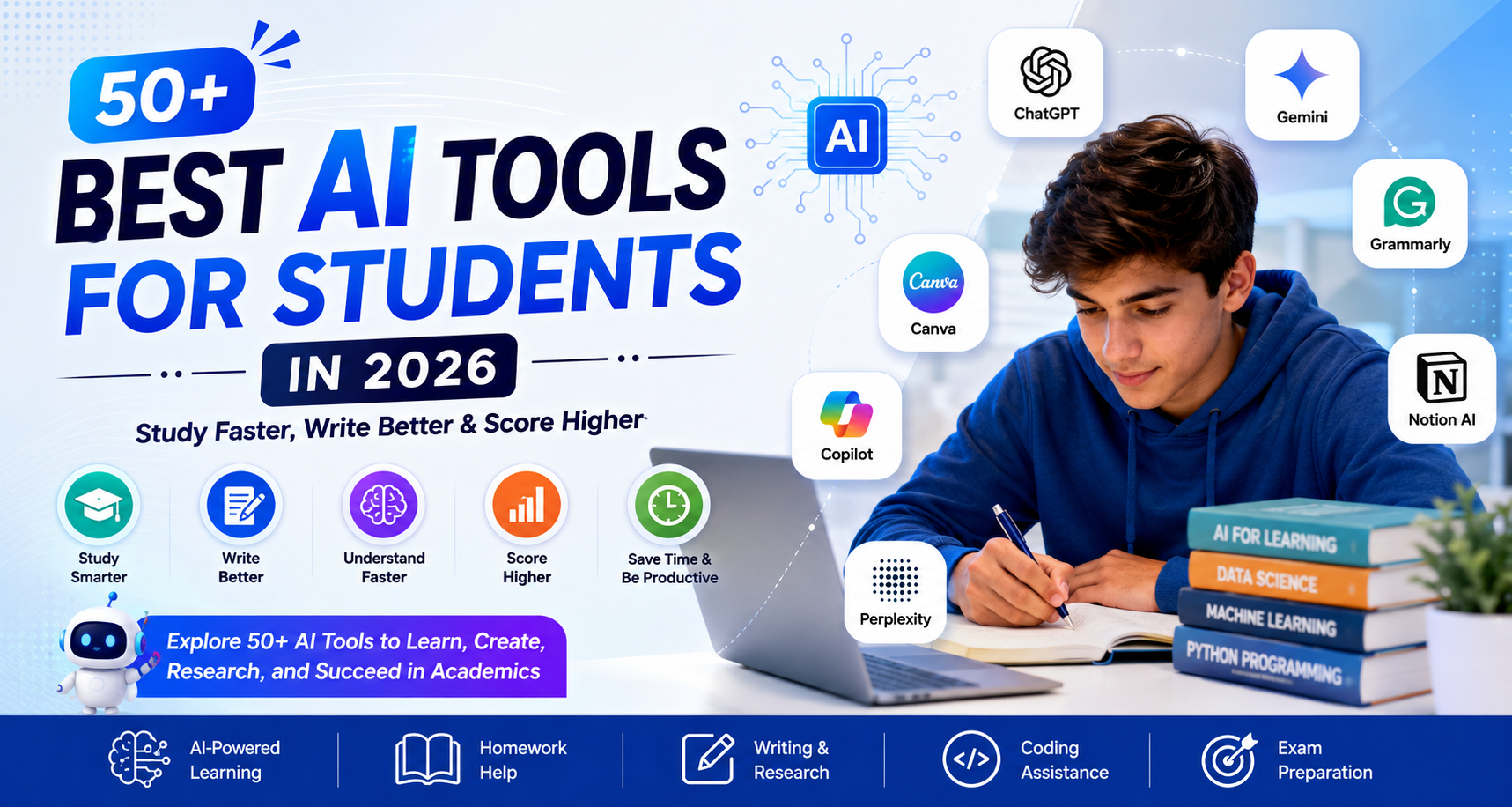
Beyond ChatGPT: The 2026 Student’s Guide to Using AI for Exam Prep Without Cheating
If you are still typing "summarize this chapter" into a general chatbot, you are vastly underutilizing the power of artificial intelligence. In 2026, AI is no longer a shortcut for cutting corners or a sneaky tool for lazy essays. Academic institutions have adapted, AI detection software has grown remarkably sophisticated, and the old-school copy-paste method is a fast track to an academic misconduct charge.
The top-performing students today aren't using AI to bypass the cognitive heavy lifting—they are using it to accelerate it. They treat AI as a ruthless personal examiner, an adaptive coach, and a 24/7 on-demand tutor.
This is the definitive, high-traffic blueprint to building an ethical, cutting-edge 2026 study stack that will help you crush your exams without ever compromising your academic integrity.
1. The "Closed-Universe" Strategy: Talk to Your Own Material
The biggest flaw of generic, open-web AI models is hallucination. If you ask a broad chatbot to explain a highly technical engineering concept or a niche legal precedent, it might generate a beautifully written, highly confident answer that is completely, factually wrong—or flat-out contradicts what your professor expects on the rubric.
The 2026 solution is the Closed-Universe strategy, pioneered by tools like Google NotebookLM.
[Your Course Materials] ──> Uploaded to Closed-Universe AI ──> Hallucination-Free Study Sandbox
The Workflow:
The Input: Upload your specific syllabus, lecture slides, text transcripts, and handwritten class notes directly into an isolated AI workspace.
The Execution: The AI is now strictly locked to your data. It cannot pull generic information from the open web.
The Prompt:
"Using only the uploaded lecture documents, quiz me on the primary mechanics of unit 3. For every answer you evaluate, provide a citation indicating the exact page number and document name it originated from."
Why It’s Completely Ethical:
You aren't outsourcing the learning; you are streamlining your navigation. You are still reading, digesting, and processing your own class material. The AI simply acts as a targeted search engine and interactive study partner built exclusively on the parameters your instructor set.
2. Automate Active Recall & Spaced Repetition
Educational psychology has universally proven that passive re-reading (staring at highlighted text) is one of the least effective ways to retain information. Highest-impact learning comes from active recall (forcing your brain to retrieve information from scratch) and spaced repetition (reviewing concepts at expanding time intervals).
In 2026, apps like Knowt and Gizmo use AI to instantly build these frameworks for you, transforming hours of tedious prep work into pure study time.
[Traditional Method] [2026 AI Method] 3 Hours: Manually writing out flashcards 3 Minutes: AI converts notes into adaptive cards 0 Hours: Active self-testing time 2.9 Hours: Pure, high-intensity active recall
High-Yield Prompt Patterns to Use:
The Custom Flashcard Generator:
"Analyze this chapter text. Generate 25 conceptual flashcards. Focus heavily on cause-and-effect patterns and mechanical 'why' questions rather than basic vocabulary terms."
The Socratic Dialogue Coach:
"Act as an expert chemistry professor. I want to test my knowledge on molecular orbitals. Ask me exactly one challenging question at a time. Wait for my response, give me precise constructive feedback, explain any errors, and then proceed to the next question."
3. The Feynman Technique on Steroids
The core of the famous Feynman Technique is simple: if you can't explain a complex topic in simple terms to a beginner, you don't actually understand it.
Instead of asking an AI to lecture you, reverse the roles. You teach the AI.
Step 1: You explain the exam topic to the AI in your own words. Step 2: AI matches your explanation against standard academic criteria. Step 3: AI uncovers your hidden blind spots and logical gaps.
The Prompt:
"I am going to explain the economic causes of the 2008 financial crisis in my own words. Act as a critical university evaluator. Do not give me the answers. Critique my breakdown, identify any logical gaps or chronological errors, and tell me exactly what vital pieces of evidence I left out."
By forcing your brain to synthesize, structure, and articulate thoughts from scratch, you simulate the exact cognitive pressure of a real exam essay or short-answer section.
4. The 2026 Code of Academic Integrity
The boundary between leveraging technology effectively and cheating is clear-cut. It ultimately comes down to a single question: Who is doing the actual thinking?
| 🟢 ETHICAL: The AI is Your Coach | 🔴 UNETHICAL: The AI is Your Ghostwriter |
|---|---|
| Breaking down dense academic jargon into plain text. | Generating paragraphs of text to copy, paste, and turn in. |
| Brainstorming unique essay angles or structural outlines. | Having AI write code for programming assignments. |
| Creating mock practice tests based on your syllabus. | Using unverified AI citations to pad a bibliography. |
| Proofreading your own original writing for structural clarity. | Using tools to alter AI-generated content to bypass detectors. |
⚠️ The Golden Rule of 2026 Study
Think of AI as a bicycle for your mind. It allows you to travel significantly faster and further than you could on foot, but it only works if you are the one turning the pedals. If the AI is generating the final answers, your brain isn't forming the neural pathways required to recall that information on exam day.
Your 3-Week AI Exam Action Plan
To systematically build long-term retention before a high-stakes exam, follow this chronological workflow:
1.Identify Gaps & Build the Sandbox:3 Weeks Out.
Review your previous quizzes and past assignments. Pinpoint your three weakest conceptual areas. Gather your lecture slides, notes, and handouts for those specific topics, and upload them into a source-grounded AI notebook (like NotebookLM) to establish your secure study environment.
2.Execute Targeted Active Recall:2 Weeks Out.
Use your AI sandbox to automatically generate flashcards and targeted diagnostic quizzes. Spend 70% of your study windows actively retrieving answers for your weakest topics. Let the AI analyze your incorrect answers, and ask it to explain why you missed them using only your course texts.
3.Run an AI-Free Mock Exam:1 Week Out.
Prompt the AI to construct a brand-new, comprehensive 30-question mock exam based on your uploaded curriculum. Print it out or open it on a blank screen. Clear your desk, close all tabs, set a timer, and complete the entire test under 100% AI-free conditions to build true, independent test-taking endurance.
The Bottom Line
Exams in 2026 are no longer designed to test basic memorization—professors know that facts are cheap and instantly accessible. Modern assessments are explicitly built to test your critical reasoning, your ability to synthesize disparate pieces of data, and your problem-solving stamina.
Stop outsourcing your brain to a screen. Start outsourcing your friction, automate your preparation mechanics, and use artificial intelligence to become the most thoroughly prepared student in the lecture hall.
Here are 50 frequently asked questions (FAQs) for "Beyond ChatGPT: The 2026 Student’s Guide to Using AI for Exam Prep Without Cheating." This comprehensive list is broken down by topic to cover every angle a student, parent, or educator might ask.
🧭 Topic 1: The Basics & Understanding the "Ethical Line"
1. What does it mean to use AI as a "study coach" versus a "ghostwriter"?
Using AI as a coach means it helps you understand concepts, quizzes you, and structures your schedule—you do the thinking and writing. Using it as a ghostwriter means you let the AI generate the final text, code, or answers that you submit as your own work.
2. Is it considered cheating if I ask AI to explain a concept I don't understand?
No. Using AI to explain complex academic concepts in simpler terms is entirely ethical. It is functionally the same as asking a private tutor, watching a YouTube tutorial, or reading a textbook alternative.
3. Can AI detectors catch me if I only use AI to study?
AI detectors flag text that is written by AI. If you are only using AI to quiz you, generate flashcards, or explain topics, there is nothing for a detector to catch because the work you submit to your school is 100% written by you.
4. What is "academic integrity" in the age of AI?
In 2026, academic integrity means that any work, analysis, or code submitted under your name represents your own cognitive effort, understanding, and independent skill, even if AI helped you prepare for it.
5. My professor says "No AI use allowed." Does that apply to studying too?
If a syllabus explicitly bans all AI tools for any purpose, you must follow your professor's rules. However, many professors ban AI for assignment generation but encourage it as a study tool. When in doubt, show them your study prompts to get approval.
6. Is it cheating to use AI to brainstorm essay topics?
Generally, no. Brainstorming ideas or structural outlines with AI is ethical as long as you do the actual research, critical thinking, and writing yourself.
7. What is the single biggest risk of using AI for exam prep?
Overconfidence. If you watch AI solve a problem perfectly, your brain tricks you into thinking you know how to do it. If you don't practice doing it independently without the AI open, you will likely freeze on the exam.
8. Does using AI to check my math homework count as academic dishonesty?
Using it to see how to solve a problem step-by-step is a valid way to learn. However, copying those steps directly onto your homework without understanding them violates academic integrity.
9. Can I use AI to translate a foreign language text for my class?
If you are learning a language, using AI to do the translation for you defeats the purpose of the course and is usually considered cheating. Using it to explain a specific grammar rule, however, is ethical.
10. Why is copy-pasting AI text so easy for schools to catch in 2026?
AI detection models in 2026 look beyond basic word patterns; they analyze semantic consistency, stylistic signatures, and structural predictability. Furthermore, most universities use continuous-monitoring tools that flag sudden jumps in writing quality.
🛠️ Topic 2: Tools, Workflows, & The "Closed-Universe" Method
11. What exactly is a "Closed-Universe" AI strategy?
It is a method where you restrict an AI model to search only within a specific set of files you provide (like your own lecture notes or textbook PDFs) rather than pulling random, unverified data from the open internet.
12. What is Google NotebookLM, and how does it help students?
NotebookLM is an AI-powered note-taking tool. When you upload your study materials, it builds a personalized AI assistant that answers questions, creates study guides, and generates quizzes based strictly on your uploaded documents.
13. Can I trust a standard chatbot (like basic ChatGPT) with specific textbook formulas?
No. Standard, open-web chatbots are prone to "hallucinations"—they can confidently invent realistic-looking formulas or historical facts that are entirely wrong. Always cross-reference or use a source-grounded model.
14. What are the best AI tools for creating flashcards in 2026?
Tools like Knowt, Gizmo, and AnkiBrain are leading the space in 2026. They allow you to drop in a lecture slide deck or video transcript and instantly generate active-recall flashcard decks.
15. Is it safe to upload copyrighted textbooks into AI study tools?
For personal study use, uploading a textbook you own into a private workspace (like NotebookLM) generally falls under fair use for educational purposes, as long as you do not share or distribute the model publicly.
16. How do I turn a long lecture transcript into an AI podcast?
Advanced AI features in tools like NotebookLM can automatically synthesize your written notes into an audio discussion featuring two AI hosts. You can download this file and listen to it during your commute.
17. What is an "AI hallucination," and why is it dangerous for exam prep?
A hallucination is when an AI generates an answer that sounds highly authoritative and grammatically flawless but is factually incorrect. If you memorize a hallucinated fact, you will lose points on your test.
18. Can AI read my handwritten notes?
Yes. By 2026, optical character recognition (OCR) inside major AI platforms can easily read, structure, and quiz you on messy, handwritten tablet notes or scanned notebook pages.
19. Can I use AI to summarize a 500-page reading assignment?
You can use it to get a high-level overview of the major themes, but relying only on the summary means you will miss the nuance, specific examples, and data points that professors love to put on exams.
20. How do I format a prompt to make AI act like a strict grader?
Assign it a specific role. Use: "Act as a strict university professor grading an essay question. Do not give me the answers. Read my response below and give me a harsh critique of my logical gaps."
🧠 Topic 3: Study Techniques (Active Recall & Feynman Method)
21. Why is passive reading a trap, and how does AI fix it?
Passive reading feels comforting because it's easy, but it doesn't build long-term memory. AI fixes this by instantly turning passive text into active challenges—like interactive quizzes or fill-in-the-blank exercises.
22. What is the Socratic Method prompt pattern?
It is a prompting technique where you instruct the AI to ask you only one question at a time, wait for your specific answer, evaluate your input, and then move to the next question—mimicking an oral exam.
23. How do I use AI for the Feynman Technique?
Instead of asking the AI to explain a topic to you, you type out an explanation of the topic as if you were teaching it to a child. You then ask the AI to find the flaws, omissions, or errors in your explanation.
24. Can AI help me study for abstract or creative subjects like art history or literature?
Absolutely. You can prompt the AI to draw thematic connections between different historical eras or literary movements, or ask it to debate you on a specific interpretation of a text.
25. How can I use AI to practice for a timed essay exam?
Ask the AI to generate an exam prompt based on your syllabus. Set a physical timer on your desk, write the essay in a blank text document without looking at your notes, and then feed your finished essay to the AI for a critique.
26. Can AI generate realistic multiple-choice questions?
Yes. If you provide it with your class notes, it can generate multiple-choice questions complete with "distractors"—those tricky, close-but-incorrect options that professors use to test deep understanding.
27. How far in advance of an exam should I start using AI study workflows?
Ideally, three weeks. Use Week 1 for organizing data and building your AI sandbox, Week 2 for intensive active recall/flashcards, and Week 3 for pure, independent mock testing.
28. What should I do if the AI gives me an answer that contradicts my professor's lecture?
Always trust your professor over the AI. Professors write the exam and grade it. Use the discrepancy as a sign that you need to review your specific lecture slides or ask your professor for clarity during office hours.
29. Can AI help me overcome test anxiety?
Yes. Test anxiety often comes from a fear of the unknown. By using AI to generate dozens of realistic mock exams, you normalize the testing process and build psychological confidence.
30. How do I prevent AI from making studying feel boring or repetitive?
Change the formats. Have it quiz you through a text-based roleplay scenario (e.g., "Act as a doctor diagnosing a patient" for a biology exam) rather than just asking standard question-and-answer pairs.
💻 Topic 4: STEM, Coding, & Quant-Specific Prep
31. Is it ethical to use AI to debug my computer science code?
Using AI to explain a specific error message or to teach you the underlying concept behind a bug is ethical. Asking AI to rewrite the entire block of code for an assignment you are turning in is usually a violation.
32. Can AI help me study for calculus or physics exams?
Yes. You can provide a formula and ask the AI to break down the proof step-by-step, or ask it to generate variations of a specific practice problem with varying levels of difficulty.
33. How do I prevent AI from just doing my math homework for me?
When prompting, add a constraint: "Give me hints on the next step to solve this equation, but do not show me the final calculation or the final answer."
34. Can AI interpret data graphs and charts for my science exams?
Yes. You can upload an image of a complex graph and ask the AI to explain what the axes, data trends, and anomalies mean if you find the visual confusing.
35. How do I use AI to memorize anatomy or structural diagrams?
Ask the AI to generate a text-based description or a numbered list pointing to parts of a system, and then quiz you on what functions those specific parts perform.
36. What is the best way to study data structures using AI?
Ask the AI to provide real-world analogies for abstract concepts (e.g., explaining a "stack" or a "queue" using a line at a grocery store or a pile of cafeteria trays).
37. Can AI help me write practice problems for chemical equations?
Yes. It can generate unlimited unbalanced chemical equations for you to balance yourself, and then provide the fully worked-out solution steps once you are ready to check your work.
38. Why do large language models struggle with complex math, and how do I bypass that?
Many standard AI models struggle with math logic because they predict words, not numbers. To bypass this, use advanced reasoning models (like OpenAI's o1 or dedicated math-tuned AIs) that use chain-of-thought processing.
39. Is it okay to use AI to format my data tables for a lab report?
Formatting data you independently collected into a clean Markdown or CSV table is a clerical task and is perfectly ethical, provided you aren't asking the AI to fabricate or extrapolate missing data points.
40. Can I use AI to simulate an oral presentation for a technical project?
Yes. Use voice-to-text features to deliver your presentation to the AI, and ask it to respond with the top three toughest questions a panel of professors might ask you about your methodologies.
🎓 Topic 5: School Policies, Future-Proofing, & Strategy
41. How do I check my university's specific stance on AI study tools?
Look up your university’s "Academic Integrity Policy" or "Responsible Use of AI Guidelines" online. If your specific department or professor hasn't outlined a policy on their syllabus, email them directly to clarify.
42. Should I disclose to my professor that I used AI to help me study?
You do not need to disclose standard studying (like making flashcards). However, if you used AI to help refine your essay's structural outline or proofread your grammar, it is a great practice of transparency to include a brief "AI Acknowledgement" note at the end of your paper.
43. Will using AI to study turn off my own critical thinking skills?
Only if you let it give you the answers. If you use it to challenge you, critique you, and force you to dig deeper into your materials, it actually sharpens and accelerates your critical thinking.
44. What should I do if I am falsely accused of using AI on an exam or essay?
Provide your version history (Google Docs or Word edit history) to prove you wrote the text sequentially. Show your handwritten notes, your research sources, and the AI study prompts you used to demonstrate your ethical workflow.
45. How do I use AI to better manage my study schedule for finals week?
Input all your exam dates, your current layout of weaknesses, and how many hours you can commit per day. Prompt: "Create a balanced, realistic 14-day study schedule using spaced repetition blocks."
46. Can AI help me find credible, peer-reviewed sources for a research paper?
Generic bots often invent fake citations. Instead, use research-specific AI tools like Consensus, Perplexity, or Elicit, which are designed to tie every single claim to an actual, verified academic paper.
47. Is it okay to use AI to fix grammar and spelling errors in an assignment?
Most schools view basic grammar checking (like Grammarly or built-in editor tools) as completely ethical. However, if the AI completely rewrites your sentences to change your voice, it can cross the line into unauthorized assistance.
48. How do I use AI to review past exams I did poorly on?
Type in the questions you missed along with the answers you gave. Prompt: "Do not give me the correct answer yet. Analyze my incorrect logic, explain the structural misunderstanding I had, and give me a hint to solve it correctly."
49. Why are employers looking for students who know how to use AI ethically?
Employers in 2026 do not want workers who simply automate away their jobs; they want professionals who know how to co-work with AI to achieve hyper-efficient, highly accurate results while maintaining total oversight and responsibility.
50. What is the ultimate golden rule for AI use in school?
If the AI did the work, it’s cheating. If the AI made you work harder, smarter, and deeper, it's learning. Use it to increase your cognitive friction, not to remove it.