Introduction
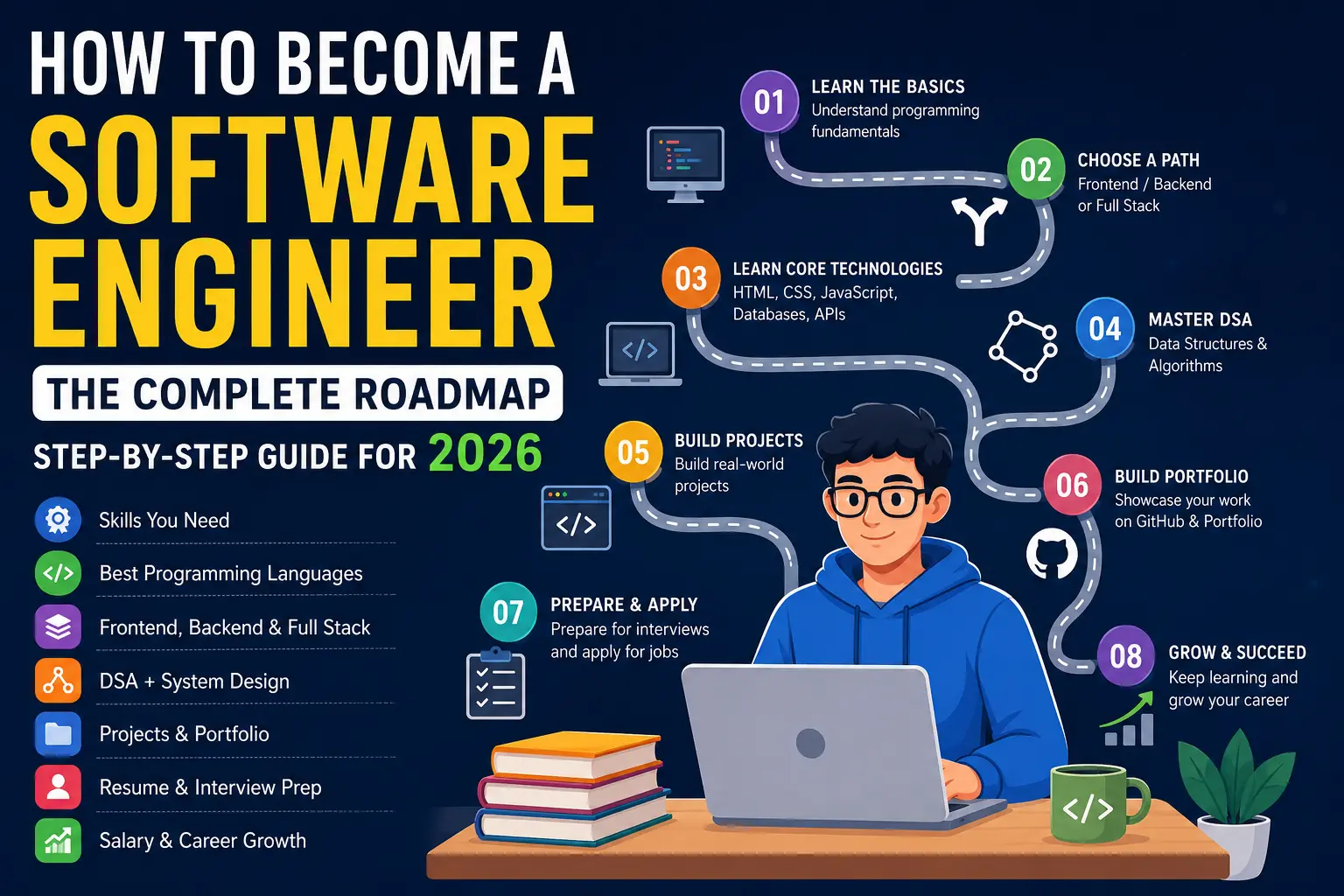
Software engineering is one of the fastest-growing careers in the world. From mobile apps and cloud platforms to AI systems and enterprise software, software engineers solve real-world problems using technology. This guide explains the complete roadmap from beginner to professional.
Why Choose Software Engineering?
- High salaries
- Global job opportunities
- Remote work
- Continuous learning
- Strong career growth
- Opportunities in startups and MNCs
Step 1: Build Strong Fundamentals
Learn computer basics, problem-solving, HTML, CSS, JavaScript, Python or Java, object-oriented programming, and basic algorithms.
Step 2: Learn Programming Languages
Start with Python or JavaScript. Then learn Java/C#, SQL, Git, and a backend language such as PHP (Laravel), Node.js, Java (Spring Boot), or Python (Django/FastAPI).
Step 3: Choose Your Career Path
Frontend: HTML, CSS, JavaScript, React.
Backend: APIs, databases, authentication, Laravel/Node.js/Spring.
Full Stack: Combine frontend and backend.
Mobile: Flutter, Kotlin, Swift.
AI/ML: Python, NumPy, Pandas, TensorFlow.
Cloud/DevOps: Docker, Kubernetes, AWS, Azure.
Step 4: Master Data Structures & Algorithms
Practice arrays, linked lists, stacks, queues, trees, graphs, sorting, searching, recursion, dynamic programming and solve problems on coding platforms consistently.
Step 5: Databases
Learn MySQL/PostgreSQL, normalization, indexing, joins, transactions, and NoSQL with MongoDB.
Step 6: Git & GitHub
Use Git for version control. Learn branching, pull requests, merging, code reviews, and open-source collaboration.
Step 7: Build Real Projects
Examples: Portfolio website, blog CMS, e-commerce application, chat app, task manager, expense tracker, URL shortener, REST API, weather app, learning management system.
Step 8: Cloud & DevOps
Understand Linux, Docker, CI/CD, GitHub Actions, cloud deployment, monitoring, logging, and basic Kubernetes concepts.
Portfolio
Publish all projects on GitHub with screenshots, documentation, live demos, and clean READMEs. Build a personal portfolio website.
Resume Tips
Keep the resume to one page for freshers. Highlight projects, internships, technical skills, certifications, GitHub, and LinkedIn.
Interview Preparation
Practice DSA, SQL, OOP, operating systems, networking basics, system design (for experienced roles), behavioral questions, and mock interviews.
Salary
India: Freshers ₹4–10 LPA, Mid-level ₹10–25 LPA, Senior ₹25–60+ LPA depending on skills and company. Global salaries vary significantly by country and experience.
Top Companies
Google, Microsoft, Amazon, Apple, Meta, Adobe, Atlassian, Oracle, IBM, Salesforce, TCS, Infosys, Wipro, Accenture, Capgemini, Zoho, Flipkart, Razorpay.
Common Mistakes
Tutorial hell, skipping projects, ignoring Git, weak communication skills, avoiding DSA, not networking, and inconsistent practice.
30-Day Beginner Plan
Week 1: Programming basics.
Week 2: HTML/CSS/JavaScript.
Week 3: Backend and SQL.
Week 4: Build and deploy a project.
Conclusion
Software engineering rewards continuous learners. Focus on fundamentals, build real-world projects, contribute to open source, and keep improving. Consistency is more important than perfection.
50 Frequently Asked Questions (FAQs) About Becoming a Software Engineer
1. What is a software engineer?
A software engineer is a professional who designs, develops, tests, deploys, and maintains software applications, websites, mobile apps, and enterprise systems.
2. What does a software engineer do?
Software engineers write code, solve technical problems, build applications, fix bugs, collaborate with teams, and improve software performance.
3. How do I become a software engineer?
Learn programming fundamentals, choose a specialization, build projects, master data structures and algorithms, create a portfolio, and apply for internships or jobs.
4. Can I become a software engineer without a degree?
Yes. Many companies hire candidates based on practical skills, projects, certifications, and coding ability rather than a formal degree.
5. Which degree is best for software engineering?
A B.Tech or B.E. in Computer Science, Information Technology, or Software Engineering is a common path, but it is not the only route.
6. Which programming language should beginners learn first?
Python and JavaScript are excellent choices because they have simple syntax and a wide range of applications.
7. Is Python enough to become a software engineer?
Python is a great starting point, but you'll also benefit from learning databases, version control, APIs, and software engineering concepts.
8. Is Java better than Python?
Both are excellent. Java is widely used in enterprise applications, while Python is popular in automation, AI, and data science.
9. How long does it take to become a software engineer?
With consistent learning, many people become job-ready in 6 to 18 months, depending on their background and dedication.
10. What skills are required to become a software engineer?
Programming, problem-solving, data structures, algorithms, databases, Git, communication, teamwork, and debugging.
11. What are data structures and algorithms?
They are techniques for organizing data and solving problems efficiently. They are commonly tested in technical interviews.
12. Is DSA mandatory for software engineering?
DSA is essential for many product-based company interviews, though some roles emphasize practical development skills more heavily.
13. What is full-stack development?
Full-stack developers work on both the frontend (user interface) and backend (server, database, APIs) of an application.
14. What is frontend development?
Frontend development focuses on creating the user interface using HTML, CSS, JavaScript, and frameworks like React or Angular.
15. What is backend development?
Backend development handles server-side logic, databases, authentication, and APIs using technologies such as Laravel, Node.js, Spring Boot, or Django.
16. Which database should I learn first?
MySQL or PostgreSQL are excellent relational databases for beginners.
17. Should I learn SQL?
Yes. SQL is a core skill used to manage and query relational databases.
18. What is Git?
Git is a version control system that tracks code changes and enables collaboration.
19. Why is GitHub important?
GitHub lets you host repositories, collaborate on projects, and showcase your coding work to employers.
20. What projects should beginners build?
Portfolio website, to-do app, weather app, blog, expense tracker, quiz app, and simple e-commerce applications.
21. Do I need mathematics to become a software engineer?
Basic mathematics is helpful. Advanced math is mainly required for specialized fields such as AI, graphics, or data science.
22. Is software engineering difficult?
It can be challenging initially, but consistent practice and project-based learning make it manageable.
23. What is the average salary of a software engineer in India?
Entry-level salaries commonly range from ₹4–10 LPA, with higher compensation possible depending on skills, company, and location.
24. Which companies hire software engineers?
Companies across industries hire software engineers, including startups, consulting firms, and major technology companies.
25. Can I become a software engineer after Class 12?
Yes. You can pursue a degree, diploma, or structured self-learning path after Class 12.
26. Can commerce students become software engineers?
Yes. With programming skills and practical experience, students from any stream can transition into software engineering.
27. Can arts students become software engineers?
Yes. Many successful software engineers come from non-technical educational backgrounds.
28. Is English important for software engineers?
Good communication skills are valuable because engineers collaborate with teammates and explain technical ideas.
29. What is object-oriented programming (OOP)?
OOP is a programming paradigm based on concepts such as classes, objects, inheritance, encapsulation, abstraction, and polymorphism.
30. What is an API?
An API (Application Programming Interface) allows different software systems to communicate and exchange data.
31. What is cloud computing?
Cloud computing provides computing resources such as servers, storage, and databases over the internet.
32. Should I learn AWS or Azure?
AWS is widely used and a popular starting point, but Azure and Google Cloud are also valuable depending on your career goals.
33. What is DevOps?
DevOps combines software development and IT operations to improve deployment speed, automation, and reliability.
34. Is Linux important for software engineers?
Yes. Basic Linux skills are helpful because many servers and development environments run Linux.
35. What certifications are useful?
Cloud certifications, language certifications, and recognized professional courses can strengthen your profile alongside practical experience.
36. Should I contribute to open-source projects?
Yes. Open-source contributions demonstrate collaboration, coding ability, and real-world experience.
37. How important is a portfolio?
A portfolio is one of the best ways to showcase your skills, projects, and practical experience to recruiters.
38. What should I include in my resume?
Technical skills, projects, internships, certifications, achievements, GitHub, LinkedIn, and relevant education.
39. How do I prepare for coding interviews?
Practice coding problems regularly, review computer science fundamentals, and participate in mock interviews.
40. What is system design?
System design involves planning scalable, reliable, and maintainable software architectures for large applications.
41. Do freshers need system design?
Basic understanding is useful, while in-depth system design is generally expected for experienced roles.
42. Can I get a remote software engineering job?
Yes. Many organizations offer remote or hybrid software engineering positions.
43. How many projects should I build before applying for jobs?
Aim for at least 5–10 well-documented projects demonstrating different skills and technologies.
44. Is freelancing a good option?
Yes. Freelancing helps you gain practical experience, earn income, and build a professional portfolio.
45. What soft skills are important?
Communication, teamwork, adaptability, time management, critical thinking, and continuous learning.
46. How often should I practice coding?
Daily practice, even for 1–2 hours, is more effective than occasional long sessions.
47. Can AI replace software engineers?
AI is changing how software is developed, but engineers who understand software design, problem-solving, and AI-assisted development remain in strong demand.
48. What are the biggest mistakes beginners make?
Skipping fundamentals, copying tutorials without building projects, avoiding Git, neglecting DSA, and inconsistent practice.
49. How can I stay updated with new technologies?
Read official documentation, follow engineering blogs, watch conference talks, join developer communities, and build projects with modern tools.
50. Is software engineering a good career in 2026 and beyond?
Yes. Software engineering continues to offer strong demand, competitive salaries, global opportunities, and diverse career paths across industries.




